Expert Searching
Inquiry learning in the music classroom has interested me for some time. Taking my specific context of high school, I decided to focus on the following question “How can the process of inquiry learning be used in a high school music classroom?”. Keywords, phrases and synonyms were identified to narrow the searches and results.
The mind map below outlines these terms in relation to the inquiry question.
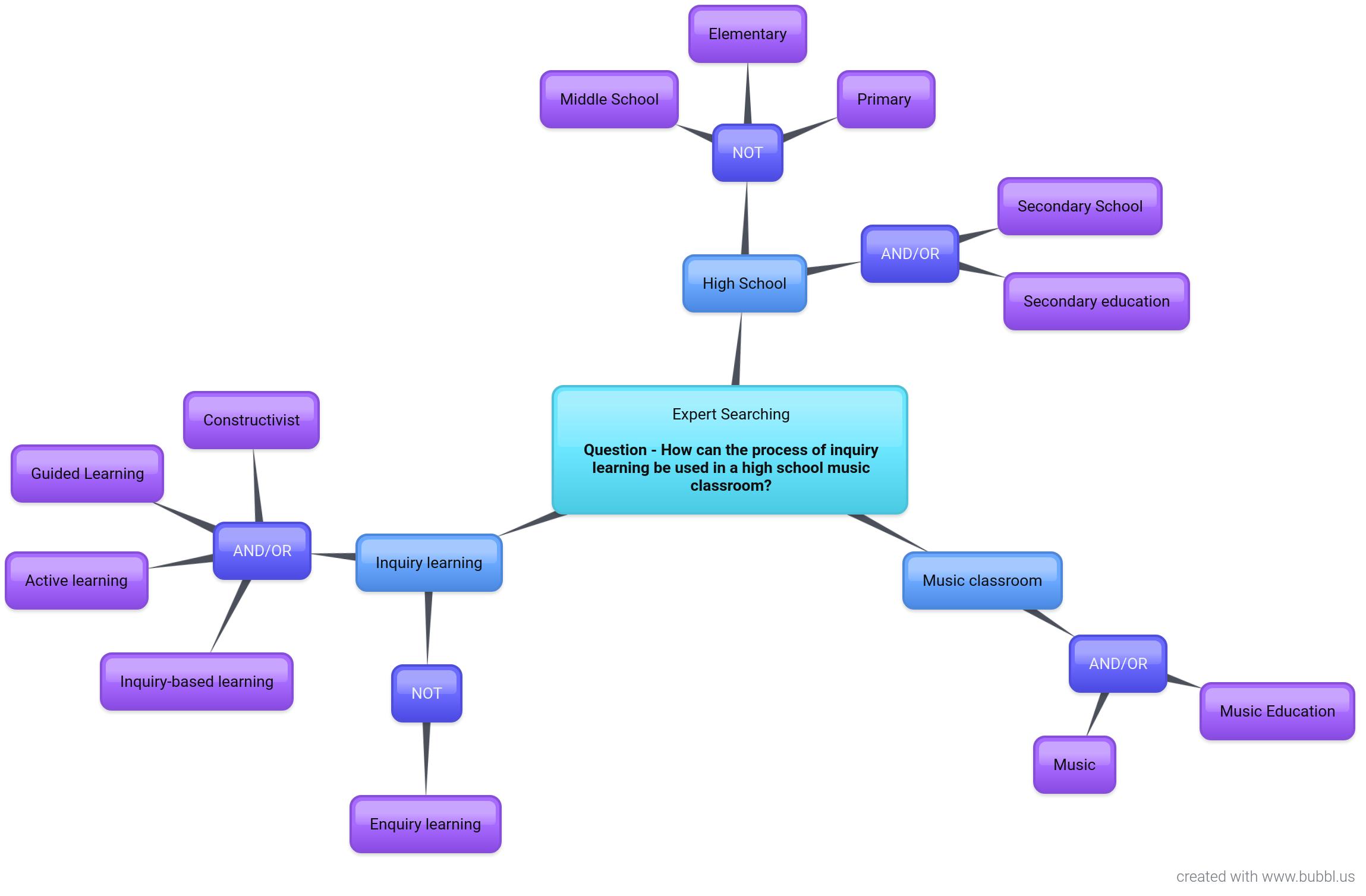
Click to enlarge.
These terms can be seen throughout the searches made on Google, Google Scholar, and Informit A+ Education.
Firstly, as many people do, I went to Google to see what I could find. Searching with google can have its moments and refining searches on google can be challenging unless you know how to narrow the searches. Google found some useful results, especially in regard to professional sources. My initial search of inquiry and music found 193 million results, many of which were not very useful. Then the process of narrowing the search began. Employing an advanced search strategy for example a Boolean search can assists in narrowing searches and returning relevant results. Adding and, or, not, + (add) or – (subtract/not) between the keywords assist in refining the results. This advanced search strategy was used when searching in Google. The table below shows the variety of search terms entered and the results they returned.
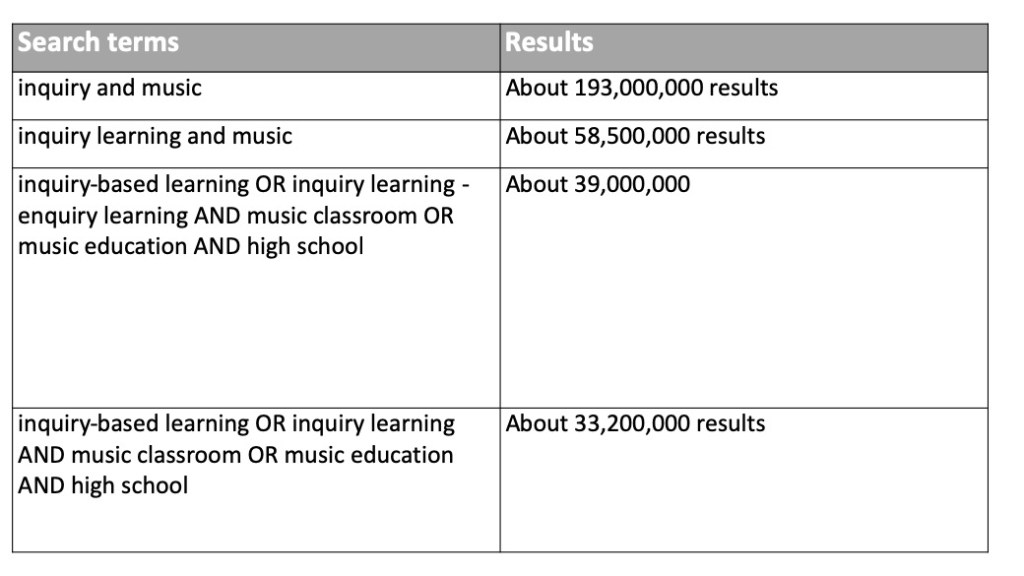
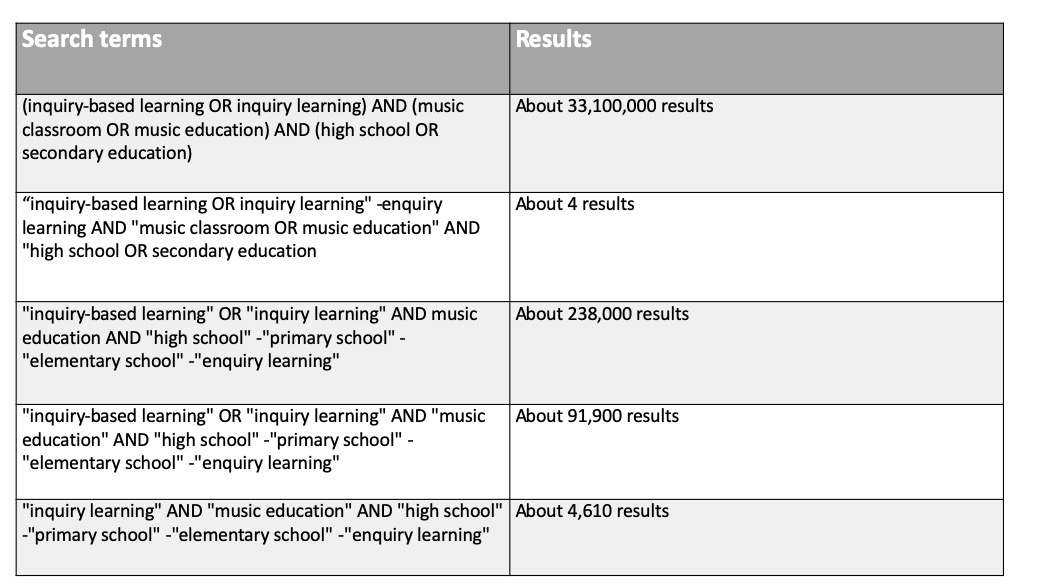
The Boolean search method assisted in narrowing down the search results and I was able to find relevant resources related to my question. The search of “inquiry-based learning OR inquiry learning” -enquiry learning AND “music classroom OR music education” AND “high school OR secondary education returned 4 results. Even though it could be thought that this is a great search with targeted results, the content within the results were not relevant to the question and my continued learning. Another strategy used within the Google search was brackets and quotation marks. These two small changes to a search term allow Google to return results using the specific words together within the quotation marks or brackets allowing for a more accurate result. For example, searching inquiry learning and music within Google returned 49.7 million results, while searching “inquiry learning” and music returned 1.43 million. The quotation marks grouped inquiry learning together as a phrase rather that inquiry and learning separately. The search results were significantly lowered when combining the Boolean search and quotation marks/brackets for searches in Google. The table below shows the results from this combination.
Google Scholar
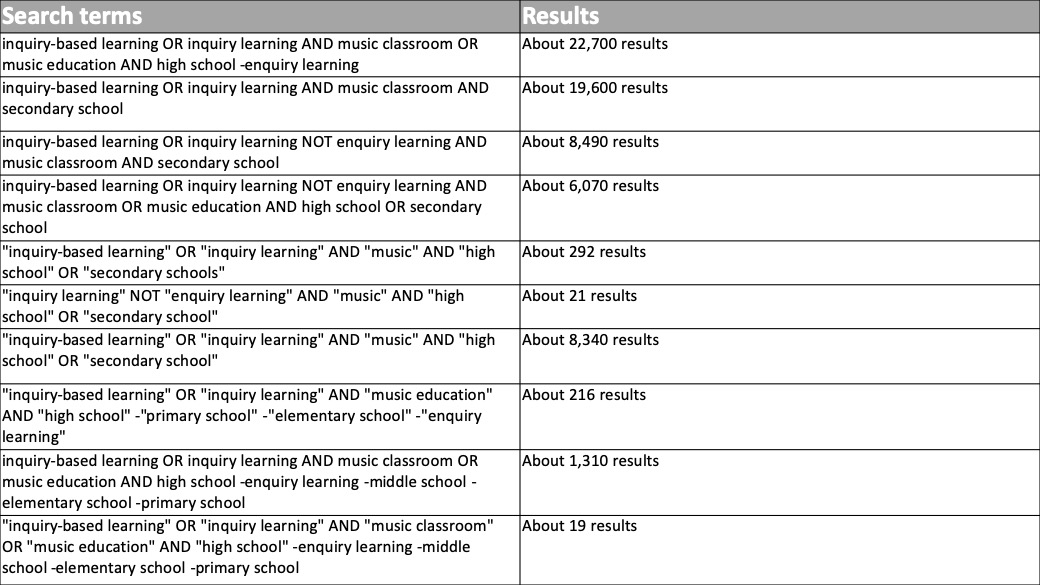
Google Scholar provided a range of results which were beneficial to my inquiry question. Searches were conducted using a range of strategies – Boolean, brackets and quotation marks. Some search terms even with different strategies being used, brought back similar results. This could be due to the key words and phrases being similar. The first search in Google Scholar was inquiry-based learning OR inquiry learning AND music classroom OR music education AND high school -enquiry learning which resulted in 22,700 items and one beneficial result on the first page “Bringing Curriculum to Life – Enacting Project-Based Learning in Music Programs”. With well above 20,000 results advanced search techniques were engaged with the results in the table below. Even though results were reduced in some cases, they still did not bring back any viable resources/results. As the phrases and key words are similar in the multiple search terms, for example inquiry learning is used in all the searches, the results will also be similar even when other changes to the search are the made. Google Scholar was beneficial in finding new resources that were different from Google.
Informit A+ Education
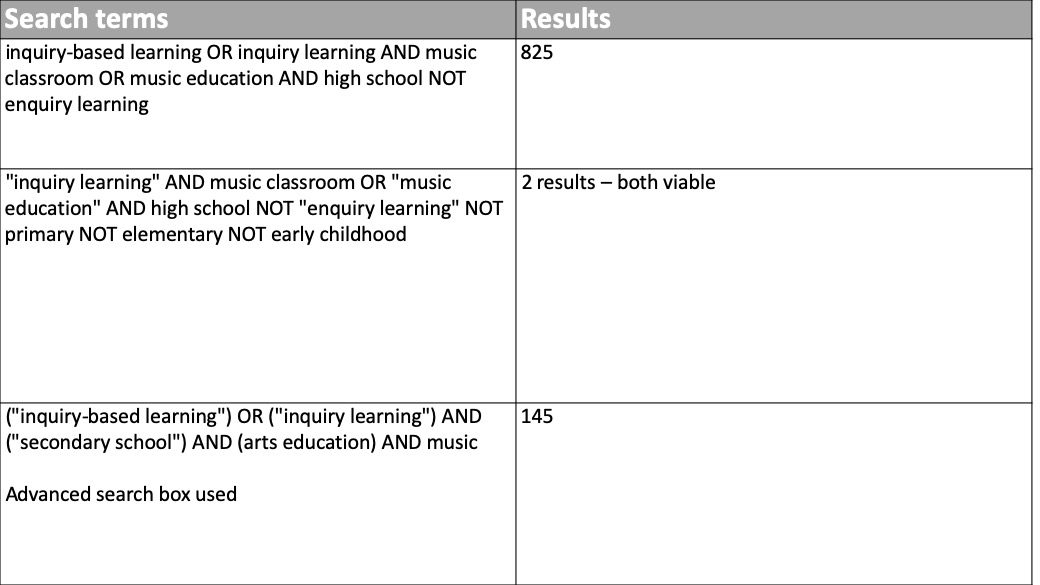
Using the Informit A+ Education database was helpful when conducting some searches. Getting the search terms right and returning accurate and viable results was sometimes difficult to manage. Throughout many of the searches conducted and making small changes to the search terms, the database was returning a lot of mathematics and science results. Trying to eliminate this with a Boolean search as well as truncation (adding NOT science and NOT math*) did not help in reducing the results. I am unsure why Informit was continuing to return results with science or mathematics in them. Using the advanced search box allowed for a more controlled Boolean search with it automatically adding in brackets and quotation marks when selecting from the drop down menu as to whether you wanted it to search the exact phrase or all terms.

There were some changes when these were selected but nothing major to report on. One of the best resulting searches was “inquiry learning” AND music classroom OR “music education” AND high school NOT “enquiry learning” NOT primary NOT elementary NOT early childhood which returned 2 results both were viable and potentially useful to the question being researched. Within the searches I was able to receive a more narrowed result from the beginning as it was limited to just the A+ education database. Having a narrowed search at the beginning assisted in less searches needing to be made and getting more targeted results.
 My Inquiry Learning Journey
Your curated collection was enlightening. Using Inquiry Learning to support Music Education is an interesting and engaging topic. With very little understanding of the area, I had a lot to learn from your collection of resources.
I was particularly enthralled with the ‘Project-Based/Inquiry-Based Learning in junior High Music Classrooms’. A ‘manual’ format of writing made a lot of sense to me. As a fellow educator, I can see the usefulness of a resource like this when planning and implementing Inquiry Learning experiences.
The collection you curated was so wonderful, there was not much room for improvement. The only request I would have made was for more studies of practice. I believe that providing more study-based article content would enhance your work with ‘evidence-based’ theory of which processes were most effective in a high school music classroom.
Ultimately, this curated collection is very useful and I am excited to explore it in further detail. The way you have elected to display your content is also commendable. I am eager to continue on the ‘journey’ with you through your blog.
LikeLike