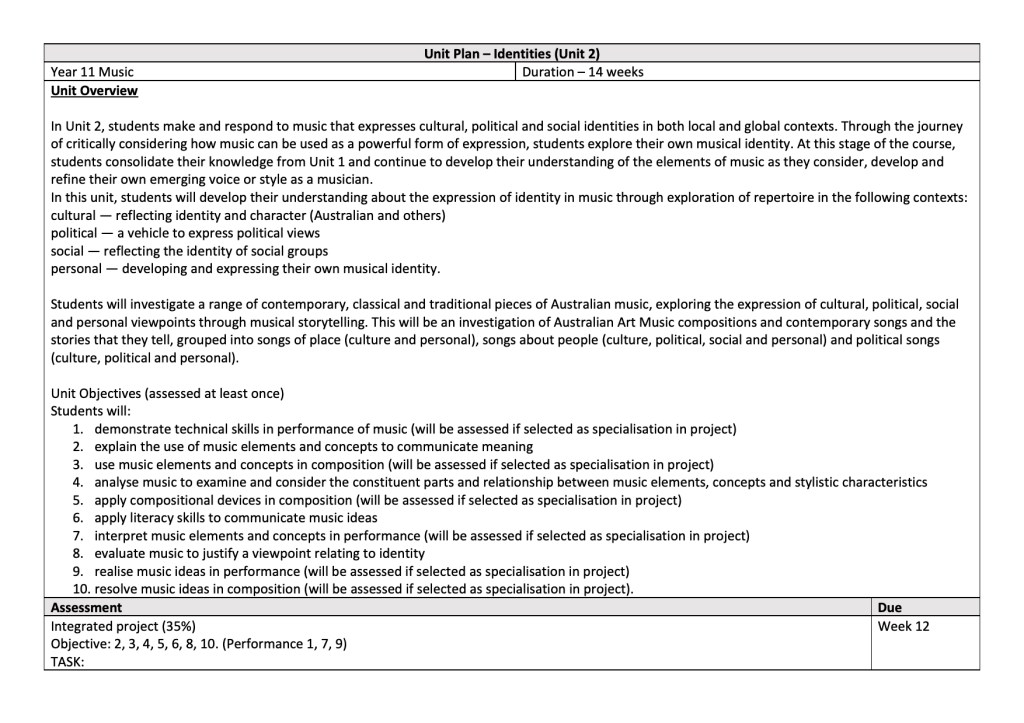
Firstly, let me set some context for my unit and with my students. I teach at a school with a high number of students who identify as having English as an additional language or dialect (EALD). Many student have had disrupted schooling and may have gaps in their learning. With this in mind, units of work need to be scaffolded in order for the students to succeed, understand and build on their knowledge and skills. There is often modelling of tasks/activities so students can understand the process and what is required (this can be seen in the unit). So with this in mind, the unit has been designed so these students can succeed, build on their music knowledge and skills and still meet the course/syllabus requirement.
Inquiry learning is a new way of unit construction in music. In the past, units have been designed around music genres, styles or eras. The new QCAA (Queensland Curriculum and Assessment Authority) senior music syllabus has a leading inquiry question that frames every unit. Within the overarching question students can explore and look at many genres of music and tailor their study to their interests. This is something I really like about the new syllabus. This unit of work allows students to form their own inquiry about music and identity. As Bell, Smetana, & Binns (2005) state “the most authentic inquiry activities are those in which students answer their own questions through analysing data they collect independently”. The overarching essential inquiry question is part of the senior music syllabus which was developed by the QCAA. The students decide on their own inquiry question for the project that takes place across the unit.
Inquiry Model
The inquiry process model that was chosen for this inquiry was the Guided Inquiry Design Framework by Carol Kuhlthau, Leslie Maniotes and Ann Caspari. This was chosen as it allowed for an extended period of inquiry to fit with the unit length required by the Senior Music Syllabus (QCAA). The variety of levels of inquiry in the framework (click here to view) allow for more steps which assists the EALD students. These steps and the scaffolding throughout the unit is aligned with the suggestion by Bell, Smetana, & Binns that a this assists students succeeding and enjoyment in the inquiry. An example of this scaffolding is in week 2 where the KWHLAQ model of questioning is used to introduce identities and fill in any gaps the students may have. The framework also worked well with the other curriculum activities in the unit. The framework is implemented sequentially with each level of the framework being guided with questions or a focus. The process model relates to the QCAA syllabus and curriculum requirements as the unit is getting students to explore music and identity through answering this question within their inquiry – How do musicians use their understanding of music elements, concepts and practices to communicate identity when performing, composing and responding to music?
Within the senior syllabus, the unit objectives shape the assessment and learning within the units of work. This inquiry unit allows for students to achieve these objectives through two assessment items. The objectives (listed in the unit plan) outline the exact cognitions the students need to achieve, as stipulated in the syllabus. The criteria or Instrument Specific Marking Guide (ISMG) for the assessment items are based upon these objectives. If students complete the relevant components of each task, they have the ability to achieve all the listed objectives. The underpinning factors of the syllabus include literacy skills, numeracy skills and 21st century skills. The QCAA syllabus states that “these skill sets, which overlap and interact, are derived from current education, industry and community expectations. They encompass the knowledge, skills, capabilities, behaviours and dispositions that will help students live and work successfully in the 21st century” (QCAA, 2018). Literacy and numeracy skills are included throughout the unit through reading music, analysing music, writing about music and reflecting on music.
Levels of Inquiry
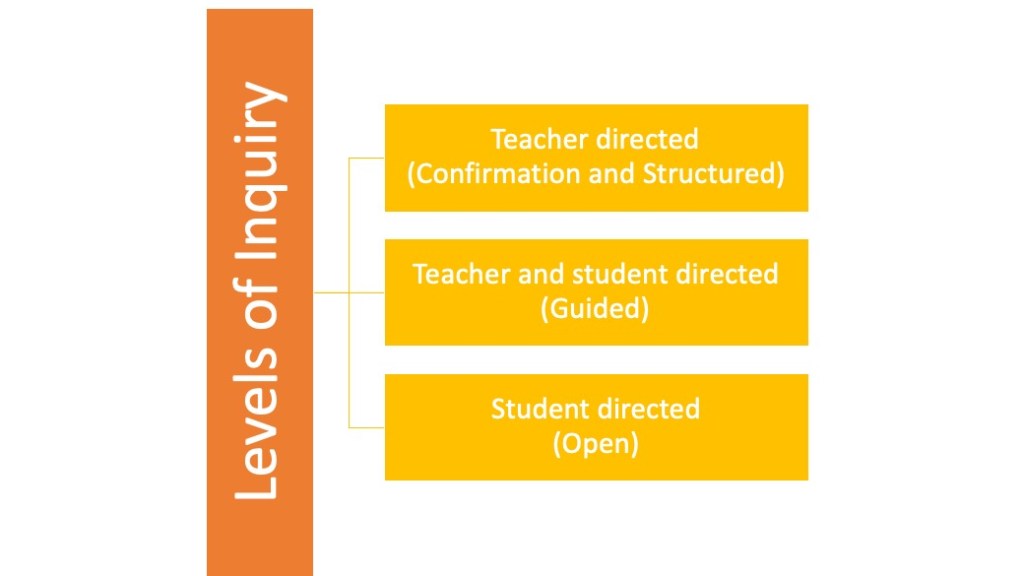
At different times in the unit, different levels of inquiry are engaged. There are times when students are taking part in teacher directed structured inquiry, for example when students are working towards the exam and practicing these skills. The teacher initiates the question and there is a prescribed procedure which the students need to follow to get the results/answers. Other learning experiences in the unit are classified as guided inquiry where the teacher is initiating the question, but the students create the procedure to get the results. The student directed open inquiry is where the students are finding their own question and creating their own procedure. Within the project, students decide their topic/focus and the question they are wanting to answer.
Throughout the project, students decide what they are going to investigate. However, this is guided by the teacher through “listening, observing, strategic questioning, timely feedback, demonstration, explanation, noticing and naming, suggesting and connecting them with resources/others who may be helpful” as Kath Murdoch (2018) suggests. The teacher will assist to make sure they are investigating within the overarching inquiry question of “how do musicians use their understanding of music elements, concepts and practices to communicate identity when performing, composing and responding to music?”. They will have a more specific question, topic and identity they are looking at. The process they use to answer this question is up to them, they can get to the end result however they like. Students gather and search for information and data in their own way. Within the model of open inquiry students decide how they evaluate information and sources. Some models will be suggested but it is ultimately up to them how they evaluate. The findings of the inquiry are presented in a presentation style as per the requirements of the syllabus. They have the choice of presenting a performance or composition which is informed by their investigation. The audience of their inquiry can be anyone, it most often will be the teacher and their peers, but they can take it further and present their findings to the wider community if they like.
Questioning frameworks

The questions students generate for their inquiry are related to the overarching inquiry topic. The essential questions (outlined in the unit plan) help support the students form their ideas and inquiry questions. Through using a generative framework model, specifically the question quadrant, the students are able to learn how to develop questions. The question quadrant “is a tool which assists teachers to explicitly teach question types with the intention of using students’ questions to guide learning” (Scholl) . This step in the process is quite important as the students need to practice this skill. With a high percentage of EALD students as mentioned previously, this step in the inquiry unit is imperative. Mandy Lupton’s GeSTE windows are a way of structuring information literacy into categories to helpful stages building in complexity. The windows start at generic (base level), situated then splits into transformative and expressive.
Firstly, the generic window questions are looked at during the beginning of the inquiry as it “deals with generic skills and processes” (Lupton, 2016). The students will build upon these questions to answer their inquiry question. These questions form their background information about the song and the identity.
For example:
- Who wrote the song?
- Why was it written?
- What is it about?
- When was it written?
- What identity is it representing?
These questions need to be re-searched as the information will be out there, the students need to use search strategies and research processes (Lupton, 2016). Through this phase of inquiry the students should also be using strategies for evaluating the information. Using the checklists examples listed in the unit plan, students can find out the success of their re-search and the viability of the information. This aspect of inquiry and questioning is generic and can be transferred to another discipline within the arts quite easily by changing a key word or two. There are very specific questions that are related to the discipline/context. For example, how has the composer used music elements to portray identity? is very specific to the music discipline. When looking at the situated window we look at information as being internal and subjective and looking at “opinions, beliefs and ideas, paradigms and world views” (Lupton, 2016). Within the requirements of the task, students have the opportunity to perform a song or create a composition based on the information they have found throughout the inquiry. This song could be anything, have any message and potentially affect the community. However, this is dependent on the students having a good inquiry topic at the start and challenging themselves enough to take action. Students may have a personal transformation through the inquiry and empower oneself or they may challenge society and take action through their inquiry (Lupton, (2016). Due to the students at the school and in the classes, they are often choosing to represent the voices that are not heard, the marginalised or the less-privileged. Most of the time it is their voices which need assistance to be heard. The students don’t have a problem in considering these topics, subjects or issues. They represent all walks of life and choose a wide range of voices. Music and the Arts are always expressive so getting students to engage with the expressive window of GeSTE is no issue. As Lupton (2016) states “the aim of the Expressive window is to build identity, express and understand oneself”. The composition and performance allow students to share their opinions, express their voice and feelings about their findings of the inquiry. They do this through answering their inquiry question. There is the potential for a student to choose the personal identity and compose a new song about themselves, which would be highly expressive.
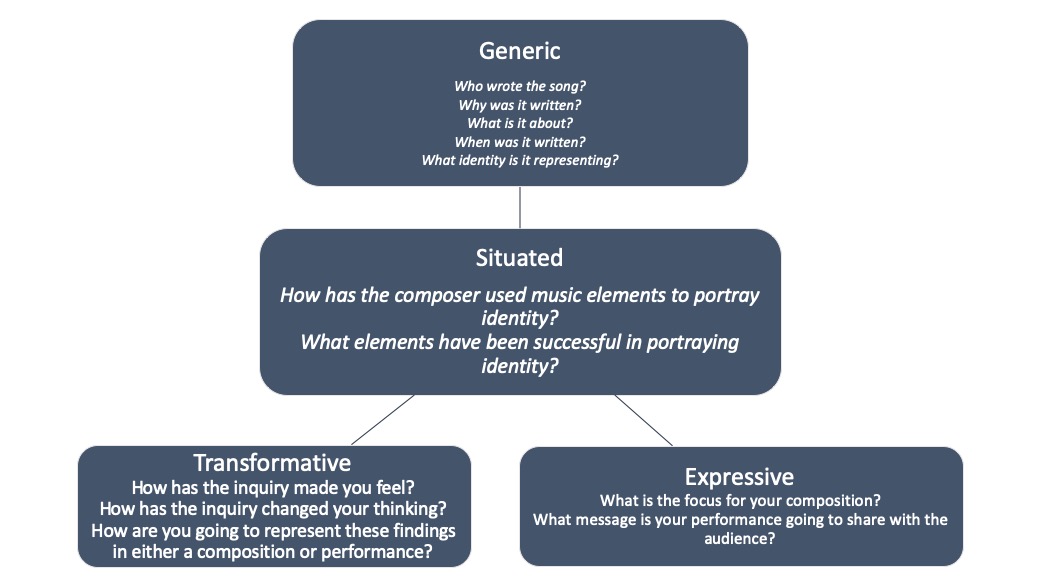
Created by author
This unit will be taught during semester 2, 2020. I feel that this unit would suit the students in the current grade 10 class (year 11 2020) and would challenge them while still supporting their inquiry learning journey. Let’s see how it goes!
 My Inquiry Learning Journey